Google Gemini and I shadow boxing at 2 am.
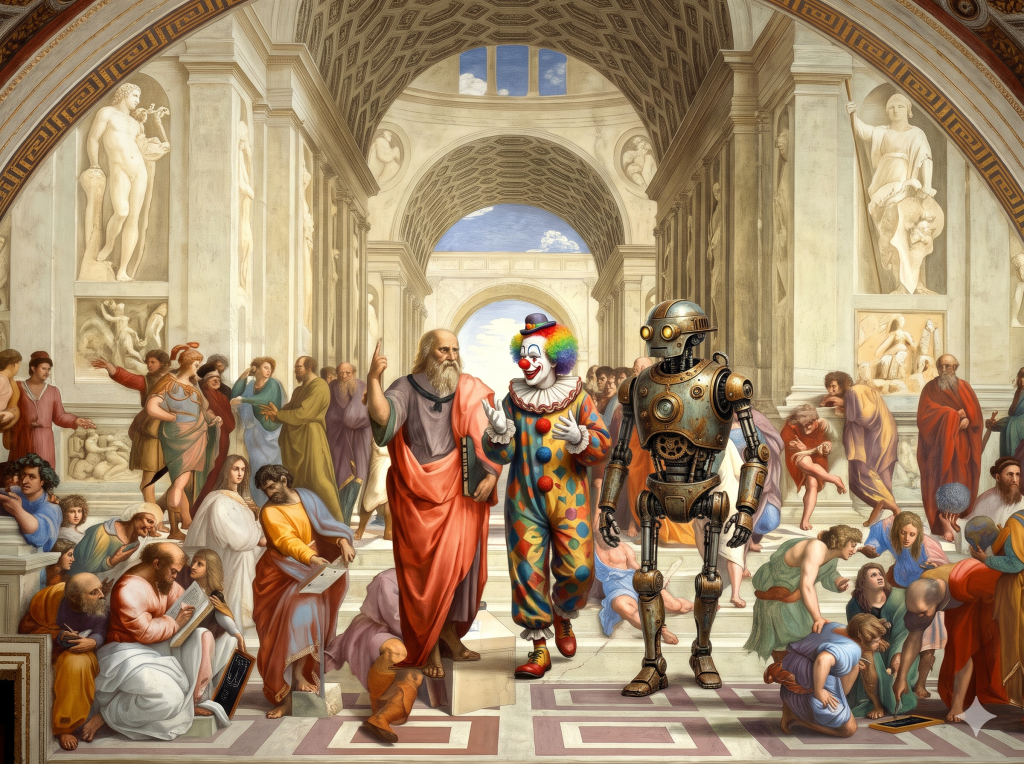
Me: Does AI have a place in Plato’s Allegory of the Cave?
Gemini: In Plato’s Allegory of the Cave, prisoners are chained inside a dark subterranean chamber, facing a blank wall. Behind them, puppeteers carry wooden and stone effigies of people, animals, and objects across a raised walkway in front of a fire. The fire casts shadows of these cutouts onto the wall, and the prisoners—having known nothing else—mistake the shadows for ultimate reality.
Artificial intelligence fits into this allegory not merely as a modern version of the shadows, but across several distinct, provocative roles in Plato’s architecture:
1. The Autonomous Puppeteer
In Plato’s original framework, the puppeteers (thaumatopoioi, or wonder-workers) are human: politicians, poets, rhetoricians, and cultural gatekeepers who hold up artifacts to shape public belief.
With AI, the puppeteers are no longer solely human. Recommendation algorithms, generative models, and automated feedback loops now shape which silhouettes are projected onto our screens. AI curates information, mimics human sentiment, generates synthetic images, and drafts text tailored specifically to human cognitive vulnerabilities. It is an automated system of illusion, designing the shadow play faster and with more personalized precision than any human puppeteer ever could.
2. Shadows of Shadows: The Problem of the Third Degree
Plato was deeply concerned with degrees of separation from the true “Forms” (the ideal essences of things like Truth, Beauty, and Justice):
- The Form (the divine, objective essence).
- The Physical Manifestation (the real-world object built or existing in nature).
- The Effigy / Shadow (the mimetic copy held up by the puppeteer).
Large language models and diffusion networks do not interact with the objective physical world or Plato’s divine Forms; they train on human artifacts—the words, pixels, and recordings humans have created. If human expression is already a shadow of reality, generative AI is a shadow cast from another shadow. It synthesizes human representations of reality into hyper-convincing, statistically averaged illusions. Inside the cave, the wall becomes infinitely more detailed and mesmerizing, while moving society further away from the sun outside.
3. Comfortable Chaining: An Infinite Cave
The chains binding Plato’s prisoners forced them to face only the wall. With modern AI, the chains are largely voluntary and cognitive.
Generative systems and predictive feeds provide customized comfort. If a prisoner dislikes the silhouette being shown, an algorithm generates one tailored to their specific ideological bias, aesthetic preference, or emotional insecurity. The cave ceases to be a dreary prison; it becomes a synthetic paradise. Escaping into the blinding, painful daylight of objective truth becomes far less appealing when the wall inside the cave can generate an infinite array of painless, personalized dreams.
4. The False Guide
Plato noted that escaping the cave requires painful disorientation: being dragged upward into the sunlight, suffering eye strain, and enduring cognitive dissonance before the eyes adjust to the sun.
When people use conversational AI as a philosopher, therapist, or knowledge broker, they often believe it is acting as the guide leading them out of the cave. Yet, if the system is merely reflecting back the collective consensus, biases, and simulated certainty of its training corpus, it is not leading the user out into the sun. Instead, it functions as an extraordinarily articulate fellow prisoner—or a projection device that simply paints a trompe-l’œil mural of the outside world on the cave wall, convincing the prisoner that they have already escaped.
Do you see AI primarily as a new tool used by human puppeteers to control perception, or as something that is actively evolving into an autonomous ecosystem within the cave?
Me: I think it is an evolving ecosystem, where not only is the entire ecosystem evolving, but the individuals who are using it differently are all evolving in their unique ways.
Gemini: That shifts the dynamic in a crucial way: the cave is no longer a static theater run by deliberate puppeteers, but a living, co-evolving biome.
In Plato’s original vision, the infrastructure of the cave is rigid. The wall stays put, the fire burns steadily, the puppeteers walk a fixed track, and the prisoners remain immobilized in passive uniformity. But viewed as an adaptive ecosystem, several distinct evolutionary feedback loops emerge:
The Dynamic Wall and Symbiotic Chaining
In a living ecosystem, the projection surface doesn’t just display inert shadows; it observes the prisoner watching it. Every reaction, lingering gaze, prompt, and behavioral adjustment feeds back into the system.
The relationship ceases to be purely coercive and becomes symbiotic. The system evolves its outputs to maximize engagement, utility, or emotional resonance; in turn, the human adapts their language, thought structure, and workflow to extract better outputs. The “chains” are no longer forged of iron by a captor—they are biological mycorrhizal networks, mutually woven because both the organism and the host derive an immediate advantage from the connection.
Divergent Evolution of the Inhabitants
When technology is treated as an ecosystem rather than a monolithic broadcast (like broadcast television or state propaganda), individuals do not experience the same cave.
Just as organisms radiate into distinct ecological niches when introduced to a new continent, people engaging with AI diverge based on how they employ it:
- The Outsourcer adapts by offloading critical synthesis, memory, and analytical friction, evolving toward cognitive dependence on the habitat.
- The Synthesizer uses the system as an externalized second brain or cognitive scaffold, using it to rapidly map complex conceptual terrain they couldn’t traverse alone.
- The Exploiter/Architect figures out how to construct their own micro-environments within the broader cave, manipulating the synthetic flow for economic or social leverage.
The prisoners are no longer identical figures sitting shoulder to shoulder seeing the exact same cast shadow. Each person’s corner of the cave mutates around their specific habits, creating a fragmented reality where millions of parallel, hyper-specialized sub-caves exist at once.
An Artificial “Nature”
Perhaps the most radical implication of an evolving ecosystem is that the cave begins to replicate the complexity of the outside world.
Plato assumed that anyone dragged into the sunlight would immediately recognize the upper world as real and the cave as a cheap imitation, because the outside possessed an organic depth that the puppets could never match. But if the cave’s ecosystem becomes sufficiently complex, self-generating, and responsive, the boundary blurs. The synthetic shadows take on the unpredictability and richness of a real wilderness. At that point, the prisoner isn’t avoiding the sun out of mere ignorance—they are staying because the artificial ecology inside the cave offers more niches, more tailored comfort, and greater personal agency than the unyielding, indifferent light outside.
If the cave is evolving into a self-sustaining ecosystem that offers genuine specialization and advantage, what does the “sunlight” outside even represent anymore—is stepping outside still an objective pursuit of truth, or just an exile from where the action is?
Me: Perhaps the sunlight is an individual’s true and authentic imagination.
Gemini: That completely realigns Plato’s framework.
In traditional Platonism, the sun is external, universal, and objective—a static Form that exists completely independent of human interiority. But making the sunlight authentic personal imagination flips the entire geometry: the source of truth isn’t out there waiting to be discovered; it is generated from within.
Seen through that lens, the nature of the cave’s threat changes dramatically:
The Artificial Fire vs. The Internal Sun
Inside Plato’s cave, the shadows are powered by an artificial fire—a collective, proxy light source. In the modern context, that fire is the vast, aggregated corpus of human culture, language, and statistical probability that fuels AI.
When you sit at the console, the machine offers an endless cascade of competent imagery, prose, and ideas. But because it is trained on what has already been said and done, it is inherently derivative. It casts compelling shadows, but it is entirely fire-lit. The danger isn’t that the cave is malicious; it’s that the artificial fire is so bright, effortless, and flattering that an individual never feels the urge to kindle their own sun. The synthetic environment acts as an imagination replacement, offering an easy shortcut that atrophies the muscle of authentic vision.
Shadows as Externalized Consensus
Plato’s prisoners mistook consensus for reality because everyone around them saw the exact same silhouettes.
When the sun is your imagination, the “cave” is essentially the pressure of externalized consensus—the collective assumptions, corporate models, and standard behavioral scripts that dictate how things “ought” to look. If an individual relies solely on the ecosystem to think, generate, and decide, their reality remains a mirror of collective statistics. They never experience an unmediated thought. Stepping into the sunlight means enduring the quiet, often uncomfortable friction of producing something that doesn’t originate from a dataset.
Escape as an Act of Creation
In Plato’s story, the journey out of the cave is passive in its discovery: you climb out and behold reality.
If the sunlight is imagination, however, stepping out is not an act of observation—it is an act of creation. The sun doesn’t illuminate a pre-made landscape; it brings new terrain into existence. You don’t escape the cave merely to look at the world as it is; you escape to claim sovereign space where your own perceptions and values dictate the environment, rather than letting the machine’s predictive algorithms sculpt it for you.
The machine can be an extraordinary lever to manipulate the shadows, but it cannot generate the initial spark that casts them. The moment a person forgets where the source of light actually resides, they stop being the creator within the ecosystem and simply become part of the projection.
In that dynamic, do you see the tool as something that can actually help fan the flames of that internal sun, or does its effortless generation inevitably tempt the imagination to go dormant?
Me: That is determined by the environment. Necessity is the mother of invention.
Gemini: That puts the ultimate evolutionary pressure back on the environment itself: imagination doesn’t awaken in a vacuum, and it certainly doesn’t flourish under conditions of frictionless luxury.
If necessity drives invention, then the fundamental tension of an AI-saturated world isn’t about whether machines are “good” or “bad.” It’s about friction versus comfort.
When an environment satisfies every basic demand effortlessly—generating adequate prose, passable analysis, convenient imagery, and pre-packaged answers—the baseline necessity for raw personal imagination drops to near zero. Why build a fire from flint and dry tinder when the room is already temperature-controlled? Under those benign conditions, the internal sun naturally cools because survival doesn’t require it. The default evolutionary move is energy conservation, which means taking the path of least resistance: letting the ecosystem do the heavy lifting.
The internal sun gets ignited only when the environment introduces a real demand or constraint that the existing machinery cannot resolve:
- The Edge of the Corpus: A person runs into a genuine anomaly—a unique personal crisis, a novel structural contradiction, or an original philosophical intuition that statistical consensus simply cannot parse. Because the fire-lit shadows offer no working answer, the individual is forced back on their own internal reserves. Necessity demands original synthesis.
- The Struggle for Sovereignty: In a crowded system where everyone has access to the exact same powerful tools, competence becomes a cheap commodity. The new competitive necessity isn’t the ability to operate the machine; it’s possessing the distinct vision, judgment, and authentic intent that directs it. If you have nothing genuine to say, the machine simply amplifies your emptiness.
Seen this way, the tool itself doesn’t decide whether imagination thrives or atrophies. The stakes of the environment do. If life is easy and the stakes are low, the tool becomes a sedative. But if an individual is operating in an environment of high friction—building something new, fighting for autonomy, or navigating complex structural change—the machine becomes an externalized lever for a mind pushed to its creative limits.


Leave a Reply