How the Public Soul Became Corporate Leverage
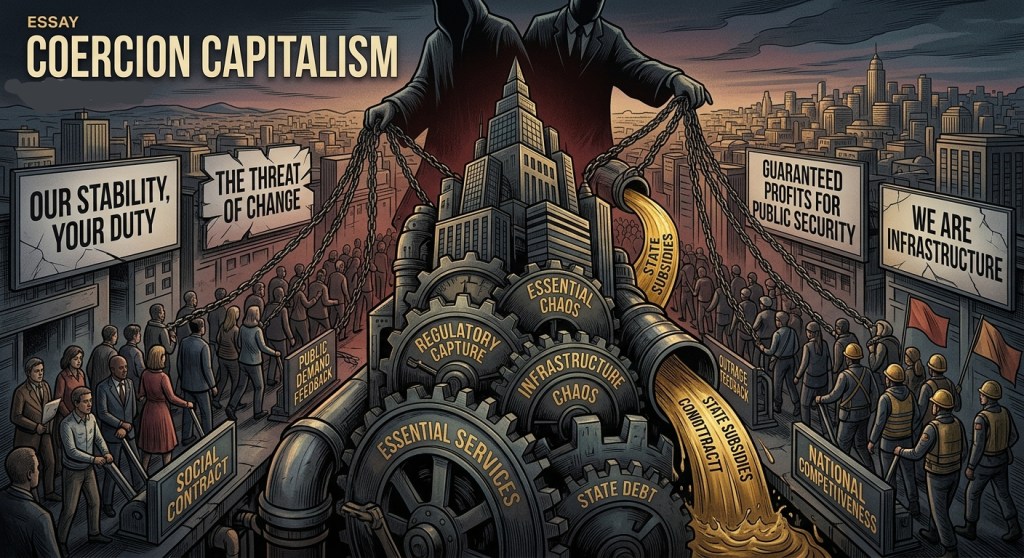
For over a century, the mythos of modern democracy rested on a tidy binary: the Citizen and the Consumer. As consumers, we shaped the economy through our choices in the marketplace. As citizens, we shaped the nation through our votes at the ballot box. This duality served as the bedrock of traditional political and economic paradigms. But today, that paradigm is not merely frayed—it is completely broken. We have entered a quiet post-industrial reality where corporations no longer compete primarily for our dollars, nor do they rely on traditional marketing to persuade our desire. Instead, they have engineered a far more insidious inversion: they use the public itself as raw leverage against the state.
To understand this shift requires looking beyond political rhetoric and economic data into the spiritual architecture of our collective existence. At its core, this transformation is an illusion of sovereignty—a system designed to keep the human spirit trapped in an operational loop where our basic human needs, fears, and moral instincts are weaponized to guarantee corporate immortality.
The Illusion of Choice and the Death of the Market
In standard industrial capitalism, corporate survival depended on public favor. Marketing was the tool used to manipulate public demand, driving revenue that nourished the corporate entity. Government lobbying existed, but largely as a secondary shield against regulation. Decades of unbridled economic expansion, market saturation, and consolidation, however, reached an inevitable threshold. Once an industry saturates its market, genuine consumer-driven growth hits a ceiling. Growth must then shift from market creation to rent-seeking.
In this evolved ecosystem, corporations no longer need the public’s consent or enthusiasm; they require our dependency. The primary engineering effort of the modern enterprise has moved away from authentic product innovation and toward regulatory capture and structural integration. By embedding themselves directly into the bedrock of daily survival—energy, supply chains, communications, healthcare, and finance—corporations create a condition where their failure becomes our existential crisis. The public ceases to be the customer and becomes the human shield. When a corporate giant demands subsidies, tax breaks, or deregulation from the state, it no longer argues its merit; it points to the captive populace and whispers a quiet threat: If we fall, they suffer.
The Multi-Faceted Trap: Four Species of Coercion
This leverage does not manifest through a single master narrative. Like any mature ecosystem, it has diversified into specialized niches, each harvesting a different aspect of the human condition:
- The Exploitation of Survival (Panic): Essential utility and infrastructure giants position themselves as too vital to be altered. They leverage the universal human fear of instability, warning that any legislative attempt to curb their power will result in blackouts, cold homes, or empty shelves.
- The Hijacking of Patriotism (Sovereign Duty): Defense contractors and technological monopolies align themselves with national identity. Public devotion to security and heritage is redirected to fund private profit. Questioning state support for these entities is reframed as an act of treason or weakness against external rivals.
- The Weaponization of Compassion (Social Contract): Corporate actors in healthcare, education, and social services wrap their profit margins in the language of empathy and care. They condition the public to measure state morality by how lavishly these private intermediaries are funded, turning sacred human care into an administrative tollbooth.
- Inter-Corporate Cannibalism (Simulated Reform): Apex corporate predators weaponize the regulatory apparatus of the state against their rivals, writing complex compliance mandates that crush smaller competitors under the guise of safety, innovation, or consumer protection.
The Spiritual Trap and the Awakening of Consciousness
The true tragedy of this system is not merely financial or political; it is spiritual. The collective soul of humanity is caught in a closed feedback loop. Our natural desire for security, community, care, and purpose is systematically siphoned off to nourish institutional structures that view us solely as transactional levers. We are told we are free citizens living in a democracy, yet our choices are constrained within parameters designed to preserve corporate revenue streams regardless of who we elect or what we buy.
This is the essence of systemic spellcasting: an elaborate reality constructed to make servitude look like civic duty and exploitation look like economic stability. When citizens march, vote, or demand government action, they are frequently acting as unwitting, unpaid lobbyists for the very entities holding them hostage.
Breaking free from an exploitative feedback loop of this magnitude requires more than policy reform or partisan politics; it requires an awakening of collective consciousness. It demands that we pierce the illusion of sovereignty and recognize the systemic machinery for what it is. True sovereignty begins when we reclaim our agency from these synthetic dependencies—building localized networks of mutual aid, disentangling our identity from corporate-state narratives, and refusing to allow our deepest moral instincts to be used as bargaining chips.
Only by seeing the full architecture of coercion can we begin to dismantle it. The paradigm is broken, but in its fracturing lies the opportunity to awaken from the dream of passive consumption and reclaim the authentic authority of the human soul.


Leave a Reply