Navigating the coming famine through Managerial Realism.
We are standing on the threshold of a quiet, inevitable shift. For decades, our culture operated under a grand, seductive promise: that tomorrow would always be cheaper, easier, faster, and more comfortable than today. We built our lives around the assumption of endless expansion, measuring our well-being by our access to friction-free living, instant gratification, and continuous personal indulgence. We treated this post-war economic boom not as a temporary season of historical abundance, but as the permanent baseline of human existence.
Now, the weather is changing. Beneath the surface of our hyper-connected world, the structural foundations are fracturing. Infrastructure decays, real-world security feels increasingly fragile, and a pervasive, quiet anxiety hangs over our communities. We are entering what can only be described as a season of economic and cultural famine—a period where the systems we relied on to guarantee our comfort begin to contract.
For those who sense the deeper, spiritual currents of life, this anxiety is not a lack of faith; it is a healthy, intuitive perception of reality. It is the spirit recognizing that an empire built on the worship of continuous consumption cannot hold. But fear is not our calling, nor is passive resignation. To navigate the coming descent, we must shed the fragile habits of an indulgent era and step into a new posture of stewardship. We must abandon the illusion of the hedonistic baseline and build the “New Family Farm”—a modern, multi-generational sanctuary centered not on routines of pleasure, but on routines of maintenance, stability, and enduring care.
The Industrial Fracture vs. The Agrarian Anchor
To understand what we must build, we have to remember what we lost. In traditional agrarian life, the household was not a place where exhausted people retreated to consume entertainment after selling their time to a corporation. The home was the sanctuary, the asset, and the enterprise. The traditional farm provided an organic, multi-generational anchor where every stage of life had intrinsic value.
In that world, as parents aged into grandparents, their shifting physical capacity did not make them disposable. They naturally transitioned into essential administrative, wisdom-bearing, and logistical roles—preservation, childcare, tool repair, and spiritual oversight. The farm provided a natural economic and physical buffer, and the family absorbed the friction of aging because everyone lived and labored within a shared, sacred ecosystem.
Industrialization shattered that holy contract. It atomized the family, pulling workers away from the home and converting human energy into hourly wages. In doing so, it transformed aging parents from revered stewards into financial burdens, leaving adult children isolated in urban centers, overstretched and exposed to every market shock. When the economic engine slows down, this fragmented, transactional lifestyle leaves us completely unanchored.
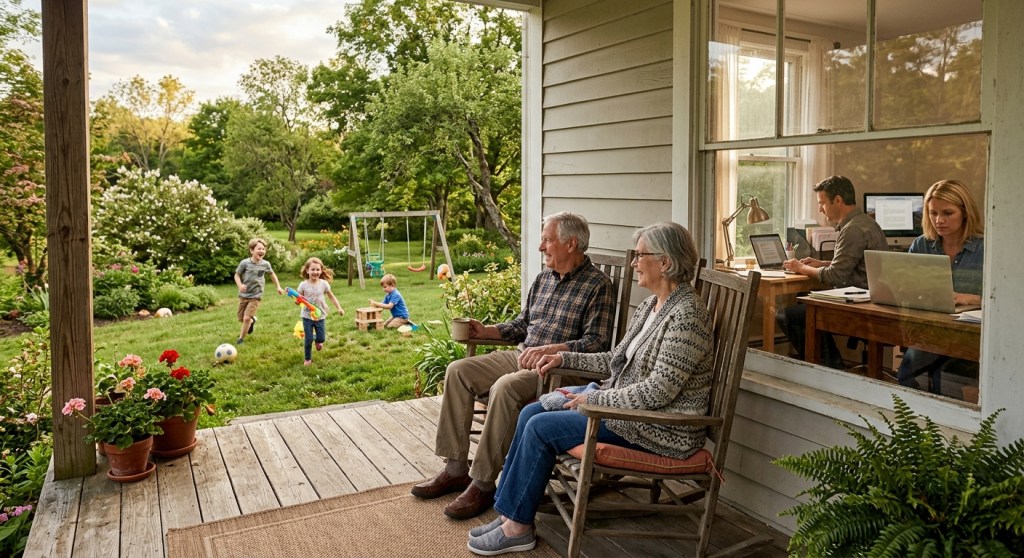
The “New Family Farm” is not a call to abandon modern life and trek out to plow a literal field. Rather, it is a spiritual and structural framework: a modern, distributed homestead built on pooled resources, shared housing, and collective security. It is a decision to stop living as isolated financial atoms and start living as a continuous, sacred line.
The Behavioral Pivot: From Comfort to Maintenance
Building this sanctuary requires a profound internal conversion. For decades, our culture trained us in “routines of pleasure”—dopamine-driven consumption, transactional relationships, performative outrage, and an obsession with personal convenience. We learned to demand that life be smooth, seamless, and tailored to our immediate desires.
In a season of famine, these habits become dangerous vulnerabilities. Survival—both physical and spiritual—demands that we transition to “routines of maintenance.”
A routine of maintenance is rooted in the quiet, noble work of stewardship. It is the willingness to find dignity in upkeep: repairing what is broken rather than replacing it, managing household resource budgets with discipline, tending to the emotional and physical needs of an aging parent, and holding space for real-world human connection. It means recognizing that true peace does not come from the absence of friction, but from the spiritual capacity to carry real responsibility with grace.
When we shift our daily focus from What can I consume today? to What can I maintain today?, the ambient anxiety that grips our culture begins to lose its hold over us. Calm replaces panic because our hands are finally engaged in meaningful, protective work.
The Architecture of the Digital Homestead
In practical terms, the New Family Farm blends ancient wisdom with modern tools to construct a resilient, multi-generational lifeboat:
- Shared Asset Management & Equity Pooling: We must move past the hyper-individualistic mindset that every adult unit must own a separate set of duplicate debt and assets. By pooling family equity—whether through shared housing, co-purchased property, or collective financial reserves—we create a family holding company that insulates every member from market volatility and housing insecurity.
- Generational Re-Integration: We must restore holy purpose to our elders. Instead of outsourcing their care to cold, monetized institutions that strip them of their life savings and dignity, we integrate them into the heart of the homestead. As their physical roles shift, they step into domestic administration, family historical preservation, and the spiritual mentoring of the young.
- Mutual Care Infrastructure: We can starve the predatory systems that extract wealth from the family unit at both ends of life. By organizing structured caregiving rotations and building hyper-local mutual aid networks with trusted neighbors, we protect our children and honor our elders within a loving, familiar atmosphere.
- Technology as a Tool for Stewardship: Rather than using smart devices and digital networks as engines of distraction, the modern homestead deploys them as simple diagnostic tools. We use technology to track energy usage, manage collective logistics, coordinate schedules, and maintain tight, loving communication across distributed family nodes.
Cultural Preservation and Sacred Lineage
A society in decline suffers above all from amnesia. It forgets where it came from, loses its moral vocabulary, and surrenders its story to whatever performative outrage is trending on a screen.
The New Family Farm serves as an ark for narrative and cultural preservation. It re-establishes the home as a place of sacred continuity, where children learn who they are through the stories of those who walked before them. It formalizes clear Rites of Passage—marking the moment a youth enters functional capability, the moment an adult steps into systemic stewardship, and the moment an elder transitions into wisdom and ultimate, peaceful release. These rituals remind us that we are not random, isolated beings floating through a meaningless universe; we are links in a long, sacred chain.
By maintaining spaces for analog connection, hands-on labor, face-to-face prayer, and local trust, we cultivate an internal sanctuary that operates entirely independent of external supply chains or political chaos.
The Calm in the Storm
When a society’s systems begin to falter, most people react with either angry denial or paralyzing fear. They bicker over who is to blame, expecting the very institutions that caused the decay to somehow step in and fix it.
Those who embrace the path of stewardship choose a different way. They step into the role of the quiet intercessor. They do not hoard resources in fear, nor do they join the noise of public panic. Instead, they pick up their tools, gather their people, and begin the calm, methodical work of building something that lasts.
The coming season of contraction is not an end to be mourned; it is a necessary clearing of the ground. It is an invitation to shed the hollow, distracting illusions of an industrial empire and return to what has always mattered: faith, lineage, duty, and deep familial love. By building the New Family Farm today, we ensure that when the winds blow and the waters rise, our homes remain places of warmth, light, and enduring peace for the generations to come.


Leave a comment