The evolution cycle of a single generation.
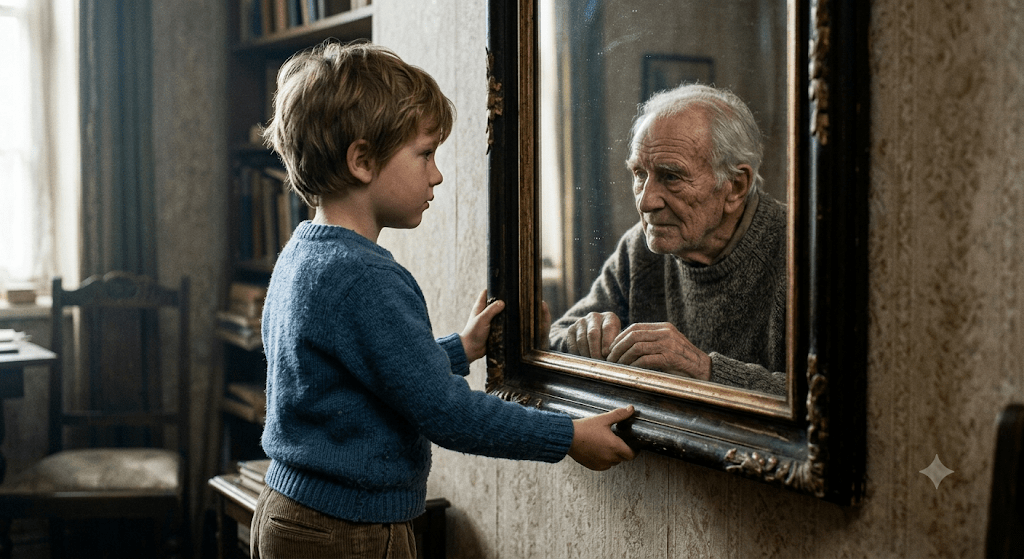
Human existence unfolds through an internal friction between fixed identity and external realities. Over the course of a single lifetime, we undergo a personal evolution cycle—a trajectory that begins with a rigid foundational self and ends with a retreat from the world.
Understanding this lifecycle is not merely a matter of self-knowledge; it serves as a critical lens through which we must evaluate leadership, societal health, and the inevitable passage of personal power.
Base Personality
In the first ten years of life, we absorb our Base Personality. Formed by an inseparable mix of nature and nurture, this foundation is heavily imprinted by our primary caregivers. It is an evolutionary artifact: highly resistant to rapid change, taking generations of slow biological and cultural inheritance to shift even incrementally. Yet, while our Base Personality remains fixed, the rest of our lives are defined by how we weaponize, maneuver, and leverage this core to gain advantage.
The Five Options and the Life Cycle
To navigate the world, human beings draw from five primary strategic options: do nothing, migrate (flight), compete (fight), adapt (changing ourselves to fit the environment), and create (changing the environment to fit ourselves). Over a typical lifespan, these strategies unfold in a sequential dance:
- Observation (Do Nothing): As young children, we first watch and learn, absorbing our initial reality without intervention.
- Early Friction (Compete): Unable to migrate on our own, childhood and early adolescence force us to fight for our personal space within the immediate family and school dynamic.
- Internal Realignment (Adapt): In late adolescence and our twenties, we activate our adaptive capacity, altering our behaviors and mindsets to fit the broader environment.
- Exploration (Migrate): Armed with experience, we leave our early environments to seek new ground.
- External Transformation (Create): Once settled, we shift from altering ourselves to shaping our environment—building careers, households, and institutions modeled on the first spaces where we successfully adapted.
- Overcrowding (Compete): Success inevitably attracts others, creating new competition for space and resources that exerts pressure on our established domain.
- Retreat (Migrate): As aging limits our energy, we migrate to somewhere quieter and safer.
- Resolution (Do Nothing): Finally, we return to a state of stillness, fading back into pure observation.
While this sequence reflects a standard lifecycle, it is not universal. Individual circumstances alter the ordering, but the underlying engine remains the same: the drive for strategic advantage, coupled with the inevitable decay of our ability to adapt as we age. As our biological plasticity fades, we are forced to abandon adaptation in favor of creation, migration, or passive retreat.
Implications for Modern Governance
This individual evolution carries heavy implications for governance. A healthy society requires leaders who are operating at the peak of their creative phase—individuals actively willing to build, innovate, and shape environments to serve the collective good.
Problems arise when leaders overstay this window. The final phase of the creative period is marked by an intense nostalgia for the environment the leader first successfully adapted to in their youth, leading to reactionary policies aimed at recreating a bygone era. Furthermore, as aging leaders begin to lose their creative drive, they inevitably enter the self-preservation stage: attempting to migrate away from public competition and hide from accountability. To maintain societal vigor, leaders must step down while still in their generative phase, long before nostalgia curtails their vision or the impulse to retreat takes hold.

 Maciolekism
Leave a comment