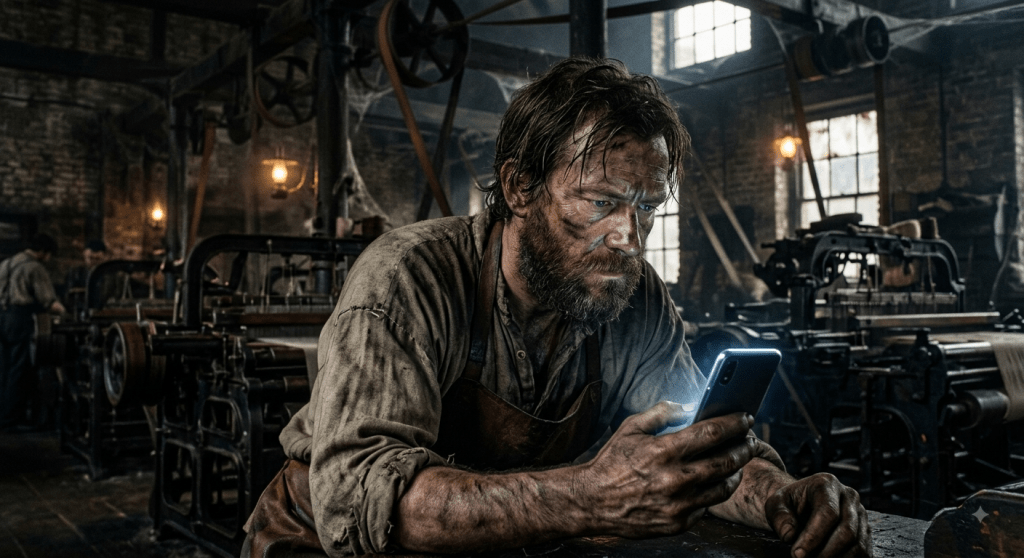
Comparing the evolution of different levels of individuality with computers, factories, and AI.
The concept of human evolution is often framed through a purely biological lens, of random genetic shifts slowly filtered by environmental pressures over millennia. Yet, human progress no longer moves at the glacial pace of biology. Instead, technology acts as an externalized genome, driving an accelerated “evolution cycle” that unfolds in three distinct steps: physical mutation, mechanical adaptation, and behavioral adaptation.
Consider a simple modern analogy: a photographer and a writer purchase their very first computers. Lacking technical knowledge, both buy the exact same model. This initial purchase represents the physical mutation; the introduction of a completely novel tool into an environment. Next comes mechanical adaptation, where both individuals undergo the frustrating, trial-and-error process of learning how to operate the hardware and software. Finally, behavioral adaptation occurs when the tool is fully integrated into their daily routines. The photographer optimizes the machine for heavy image rendering, while the writer tailors it for word processing and research. By the time they need to upgrade, their specialized habits dictate their needs; the second generation of computers they purchase will be drastically different from one another. The environment has acted on the mutation, forcing specialized divergence.
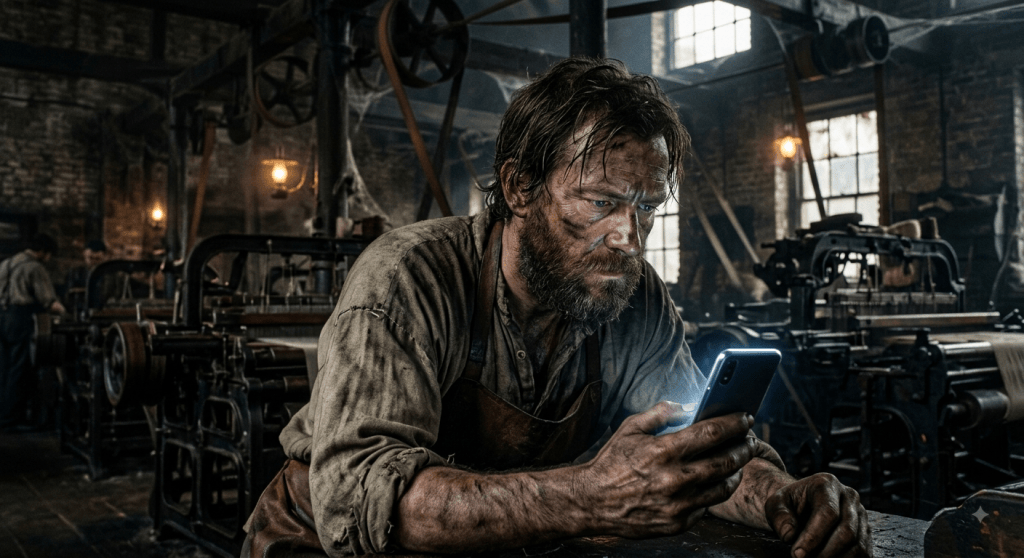
At a larger scale, this three-stage evolutionary framework directly mirrors the emergence of factories during the Industrial Revolution. The birth of the early mill or mechanized factory was society’s macro-level physical mutation. Because humanity had no prior blueprint for organizing work on an industrial scale, these early facilities were brutal, dangerous, and exploitative environments. What followed was a painful, decades-long period of mechanical adaptation. Society had to build entirely new systems—developing safer machinery, drafting labor laws, organizing trade unions, and inventing industrial management techniques to handle the physical reality of steam and steel. Ultimately, behavioral adaptation took hold as factory culture restructured human life entirely: standard work weeks, urban migration, timecard-driven routines, and the very concept of a “weekend” became deeply encoded into society’s social fabric.
Today, we are witnessing this exact same evolutionary cycle play out with the rise of artificial intelligence and autonomous flock systems. Generative models, automated agents, and algorithmic coordination are our era’s physical mutation, clumsily dropped into an unprepared societal landscape. Predictably, we are currently trapped in the chaotic phase of mechanical adaptation. Just as early factory workers fought against unsafe conditions, modern society is wrestling with IP rights, algorithmic bias, job displacement, and social justice within digital spaces.
However, the final stage—behavioral adaptation—is already taking shape. Just as the photographer and writer transformed identical computers into wildly different tools, different sectors of society will adapt AI to serve divergent, specialized needs. How we navigate our current mechanical adaptation will determine whether AI becomes an instrument of automated exploitation or a catalyst for unprecedented human capability. History shows that physical mutations are inevitable, but our behavioral adaptations are entirely ours to shape.


Leave a Reply